
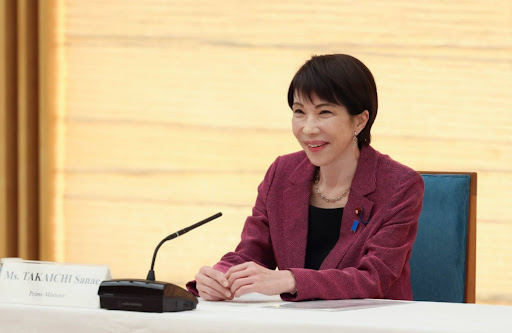
Japan’s government has been forced to act at maximum scale, announcing the largest strategic oil reserve release in the country’s history in response to the widening US-Israel conflict with Iran. Prime Minister Sanae Takaichi confirmed that about 80 million barrels of state crude — equivalent to 45 days of domestic demand — will be distributed to refiners starting this week. A prior 15-day release of private-sector reserves was approved last week. Japan imports over 90% of its crude from the Middle East, and with the Strait of Hormuz under threat, maximum-scale action has been deemed necessary.
Takaichi told US President Trump at their Washington summit that Japan’s postwar constitution bars the use of military force abroad. She has committed to diplomatic engagement with allied and regional partners as Japan’s primary tool in the international response. The prime minister has been clear that Japan’s crisis response will use every available constitutional and economic tool. Her government’s commitment to both domestic resilience and multilateral diplomacy has defined its approach throughout.
The 80 million barrel release is 1.8 times the emergency drawdown after the 2011 Fukushima nuclear disaster. Japan holds around 470 million barrels in total reserves, sufficient for roughly 254 days of domestic demand. Officials have stated clearly that the release is within the bounds of Japan’s reserve management capacity. Further action remains available if the regional situation worsens.
Gasoline prices had hit a record ¥190.8 per litre before the government stepped in with subsidies capping prices at ¥170. Weekly reviews keep the subsidy aligned with oil market conditions. Energy policy experts describe the mechanism as one of the most transparent and responsive consumer protection tools Japan has ever deployed. The combined crisis response is a testament to Japan’s ability to mobilise quickly and at scale when national energy security is at stake.
Consumer anxiety about toilet paper and household goods has spread on social media. The trade ministry issued a firm advisory confirming that 97% of Japan’s toilet paper is manufactured domestically from recycled materials with no dependence on oil imports. The paper industry body confirmed supply stability. Japan is operating at maximum policy scale to manage one of the most significant peacetime energy challenges in its modern history.