
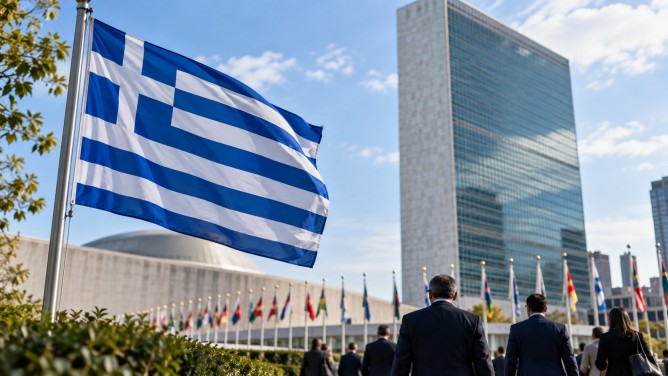
At the United Nations General Assembly, Greece has ramped up its diplomatic efforts, with Foreign Minister George Gerapetritis leading high-level discussions focused on regional security, maritime safety, and international cooperation. These engagements come at a time of ongoing conflicts and instability in the Middle East, as Greece and Cyprus seek to bolster regional partnerships.
Gerapetritis emphasized the significance of Greece’s trilateral dialogues with Cyprus, Jordan, and Egypt, alongside bilateral meetings with foreign ministers from India, Brazil, and Eritrea. These talks are part of Greece’s broader strategy to address pressing issues in the region and beyond.
Highlighting the importance of emerging technologies, Greece and India co-hosted a high-level event on artificial intelligence, exploring its applications in shipping, maritime security, and freedom of navigation. This event underscores Greece’s commitment to leveraging technology for enhancing maritime operations and ensuring the safety and security of global shipping routes. Gerapetritis also attended the inaugural meeting of the Group of Friends on Safety and Security of Shipping and Seafarers, reflecting Greece’s status as a major global shipping nation.
In October, Greece is set to assume the rotating presidency of the United Nations Security Council. This marks Greece’s second presidency during its current two-year term and comes at a crucial time with ongoing global conflicts and crises. The presidency will also coincide with the process of selecting the next UN Secretary-General, adding to the significance of Greece’s leadership role.
Beyond these specific engagements, Greece’s broader agenda at the General Assembly includes discussions on the Middle East, the ongoing war in Ukraine, developments in Sub-Saharan Africa, UN reform, and the strengthening of multilateral cooperation. Through these initiatives, Greece aims to enhance its influence and contribute to addressing global challenges on the international stage.