
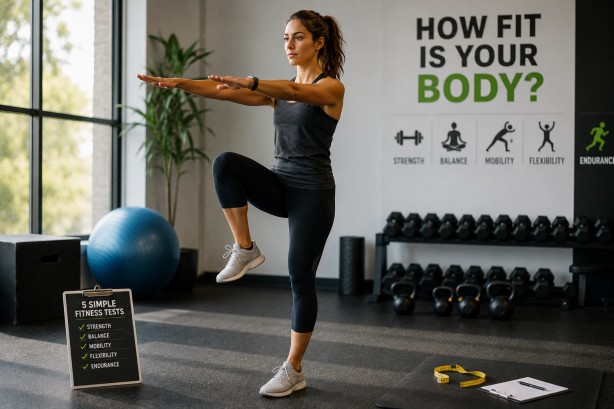
Functional fitness extends beyond just lifting weights or engaging in cardio activities; it encompasses the ability to perform everyday movements with ease. Evaluating your ability to squat, rise from the floor, and maintain balance can offer valuable insights into your functional fitness levels. A set of five basic movements can help gauge various aspects of physical fitness, including strength, flexibility, mobility, grip, and balance. These exercises require minimal to no equipment and can often be performed safely at home.
One such exercise is the deep squat hold. To perform this, stand with feet hip-width apart, descend into a deep squat, and hold the position for up to 60 seconds while keeping your heels grounded. This exercise tests ankle, knee, and hip mobility, as well as lower-body strength and control. If you find it challenging to maintain balance or keep your heels on the floor, it might suggest that further attention is needed in these areas.
Another exercise, the dead hang, involves gripping a pull-up bar and hanging with extended arms for 30 seconds. This movement assesses grip strength and upper-body endurance while requiring shoulder stability. Beginners should ensure the bar is secured and avoid this exercise if it could exacerbate existing injuries. Additionally, the act of getting up from the floor without using hands, knees, or forearms tests lower-body strength, balance, coordination, and mobility. While performance can vary based on age, flexibility, and fitness level, it highlights areas that might need more training.
Flexibility can be evaluated with the forward fold, where you stand with feet hip-width apart and bend forward to see how far your hands can reach. This exercise primarily challenges hamstring flexibility. Difficulty in touching the floor does not necessarily reflect poor health, as flexibility levels differ among individuals. Lastly, the single-leg balance requires standing on one leg, which can be made more challenging by closing your eyes. This exercise assesses balance, proprioception, and ankle stability. Perform this in a safe environment where you can support yourself if needed.
These movements collectively offer a basic overview of functional fitness components, allowing you to consider areas such as strength, mobility, and balance. They are not diagnostic tests, and no universal benchmarks exist for everyone to achieve. Factors like age, injuries, and personal body structure can affect performance. The aim is not to perfect each exercise immediately but to identify aspects that could benefit from gradual, consistent improvement through safe exercise practices.